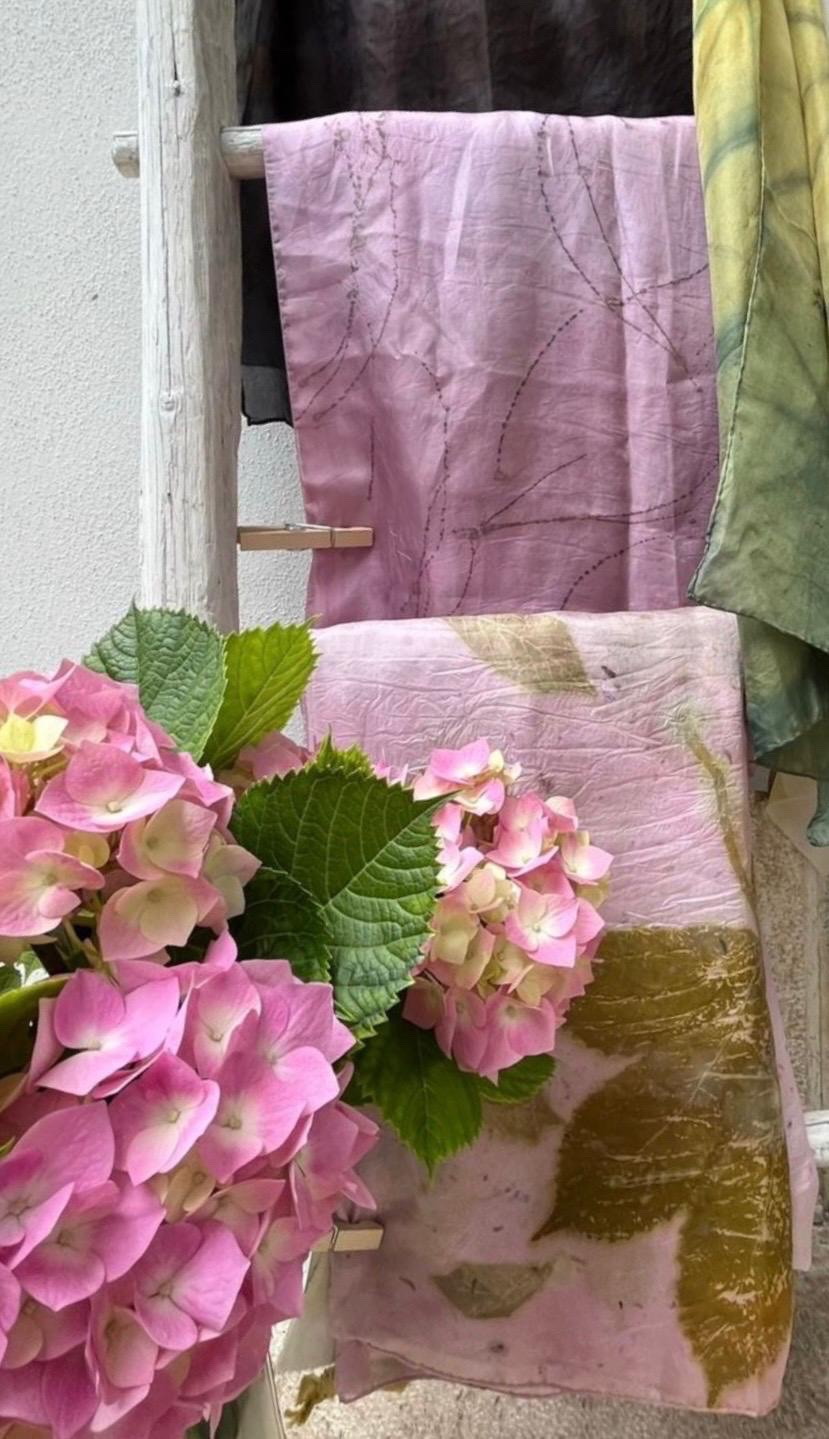
How to wash a plant-dyed silk.
A silk dyed with leaves and roots is not a fragile silk: it is a living one. The colour sits inside the fibre rather than on top of it, and it fears only three things — direct sun, hot water, and detergents made to lift colour out. Everything else is simpler than it sounds.
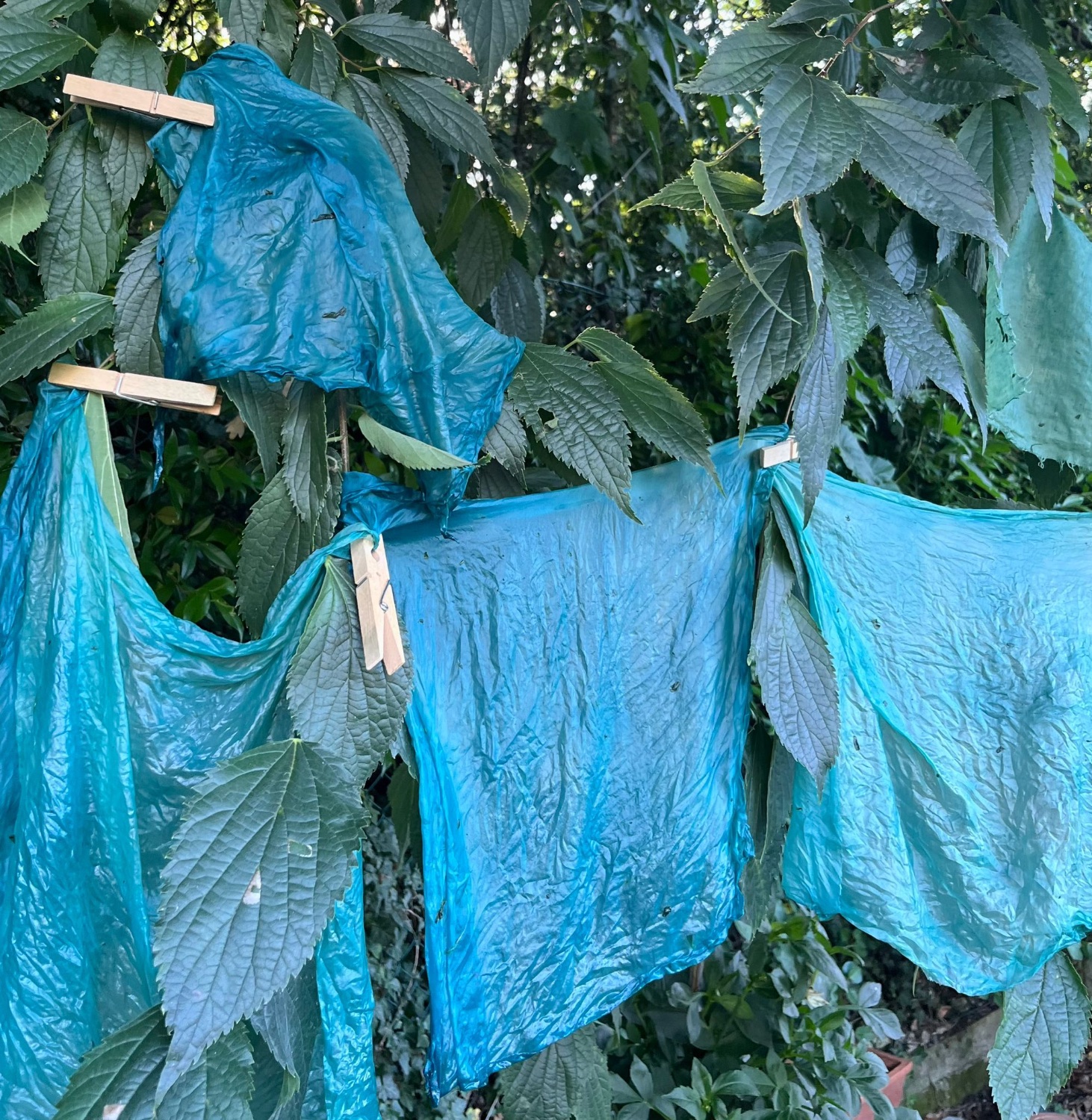
Six movements, always the same.
-
01
Cold water, never hot.
Wash by hand in cold or barely tepid water: above thirty degrees a plant dye begins to give, and the silk loses its tension. One basin, five minutes, no long soaking.
-
02
A neutral soap, two drops.
Pure Marseille soap, or a wool-and-silk detergent with no enzymes, no brighteners and no heavy perfume. Two drops are enough for a scarf: too much soap is the quickest way to dull a colour.
-
03
Do not rub.
Submerge it, move it gently with your hands for a minute, rinse in cold water until the water runs clear. No rubbing and no brush: a botanical print is a drawing laid on the weave, and friction wears it away.
-
04
Do not wring.
Press the water out between two white cotton cloths, as you would with a cashmere sweater. Never wring, never spin: wet silk marks, and the crease stays.
-
05
In the shade, laid flat.
Lay it flat on a dry cloth, in the shade, where the air moves. Direct sun is the one thing that truly puts out a plant dye: two summer afternoons on a balcony are worth ten washes.
-
06
A low-steam iron.
Press from the reverse while it is still slightly damp, with low steam. Strong heat on dyed silk yellows a pale ground: two light passes are better than one heavy one.
Three enemies, and no others.
It turns the yellows, lifts the indigo, greys the browns. A dyed silk keeps best folded in a drawer or hung in the dark — not over a chair by the window.
Washing machine, radiator, tumble dryer: anything that heats opens the fibre and lets the pigment go. No hand-dyed piece goes into a machine, not even on the delicate cycle.
Enzymes, percarbonate, bleach, oxygen stain removers: they are made to take colour out, and they do it beautifully to ours as well. The same goes for any “brilliant white” detergent.
At once, with cold water.
Blot from the reverse with a white cotton cloth wetted in cold water, working from the edge of the mark inwards. Never rub, and never use a stain remover: on a plant dye it leaves a pale halo that does not come back.
For wine, oil and make-up, write to us before you try anything: we have remedied almost everything in the atelier, and it is often solved with a partial re-dye that cannot be seen.
Not washed: brushed.
Wool, cashmere and alpaca want brushing with the nap and a night's rest in the air, on a broad hanger. That is enough for a whole season.
If a clean is needed, ask for a gentle dry clean in a hydrocarbon solvent rather than perchloroethylene, which draws tone out of a plant-dyed lining. And if the lining marks, we will re-sew it ourselves.
Our garments can be mended.
A hem that gives, a lost button, a colour that has caught the sun: write to us. We sewed every piece one at a time and we know where to go in. Small repairs are always included.
Write to usHow they last.
Every fibre ages in its own way: linen softens, hemp pales, wool felts a little and turns warmer for it.